




Beyond Borders: Why Emerging Markets Are the Future of Your Investment Portfolio
Anúncios
Unlocking growth in volatile economies: A strategic guide to capitalizing on the next global financial shift.
In the stylized world of finance, Wall Street, London, and Tokyo have long dominated the narrative. But the global economic landscape is undergoing a seismic shift. While developed markets grapple with demographic stagnation, political polarization, and saturated industries, the real story of growth is being written elsewhere. Welcome to the era of Emerging Markets (EMs)—the dynamic, fast-growing economies of Asia, Latin America, Africa, and Eastern Europe. These markets are no longer just the “factories” of the world; they are rapidly becoming its innovation hubs, its largest consumer bases, and the epicenters of technological adoption.
Ignoring EMs is no longer a prudent, conservative strategy; it’s a significant diversification failure. The potential for alpha—returns exceeding the benchmark—is exponentially higher in markets that are just beginning to realize their potential. From the fintech revolution in Southeast Asia to the renewable energy boom in Latin America, the opportunities are vast. However, this potential does not come without complexity. Volatility, political risk, and currency fluctuations are the price of admission. This guide is designed not to scare you away, but to equip you. We will analyze how to strategically allocate capital, manage risk, and identify the long-term structural trends that separate temporary noise from genuine opportunity. If you are serious about building a resilient, high-growth portfolio for the next decade, understanding the nuances of world finance, starting with emerging markets, is no longer optional. It is essential.
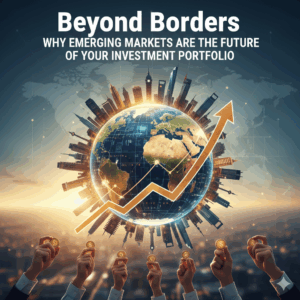
The Alpha Frontier: The Unbeatable Advantages of Emerging Market Allocation
How strategic EM investment supercharges diversification and captures the exponential growth developed markets can no longer offer.
Look Beyond the “BRICS”
The original BRICS (Brazil, Russia, India, China) are yesterday’s news. Today, smart money looks at the “Next 11” or focuses on specialized tech hubs. Tip: Analyze countries with high “digital penetration” but low “credit penetration”—it’s a goldmine for fintech growth.
The Demographic Dividend
While the West is aging, many EMs (like Vietnam or Nigeria) have incredibly young, tech-savvy populations. Curiosity: This creates a “demographic dividend”—a massive, built-in consumer base ready to spend for decades.
ETFs are Your Best Entry
Don’t try to pick individual stocks in unfamiliar legal systems. Pro Tip: Start with broad-market (like $VWO or $IEMG) or region-specific (like $INDA for India) ETFs to instantly diversify and reduce single-stock risk.
Currency is a (Hidden) Asset
Most investors fear EM currency volatility. Tip: Use dollar-cost averaging to buy EM ETFs. This strategy naturally buys more assets when the local currency is weak (and assets are cheap) and less when it’s strong.
Navigating the Maelstrom: Understanding the Real Risks Before You Invest
Volatility and politics are part of the game. Here’s how smart investors mitigate, rather than avoid, the inherent challenges of EM investing.
The Specter of Political Risk: It’s true that emerging markets can experience abrupt political changes, regulatory shifts, or governance issues that developed markets rarely see. This “headline risk” can cause sharp, sudden downturns. However, this is precisely why these assets offer a higher risk premium (i.e., higher potential returns). Smart investors mitigate this not by timing the market, but by using broad ETFs. A crisis in one country (e.g., Turkey) will have a muted impact on a fund that also holds assets in Korea, Taiwan, and Brazil.
Currency Fluctuation Anxiety: Yes, a strong dollar can be a headwind for EM assets. When the local currency weakens against the dollar, your returns can be eroded upon conversion. But this is a two-way street. When the cycle turns (as it inevitably does), a weakening dollar supercharges your returns. Viewing currency as a short-term risk misses the long-term picture: you are buying into the fundamental economic growth of the country, not just its daily exchange rate.
In today’s hyper-connected world, finance is no longer a local affair. The concept of “World Finance” represents the intricate, high-speed network of capital, debt, and assets flowing across borders, dictating everything from your mortgage rate to the price of your morning coffee. While seasoned investors are comfortable analyzing the S&P 500 or the FTSE 100, the most transformative—and often misunderstood—segment of global finance lies in the developing world. We are talking about Emerging Markets (EMs).
For decades, these economies were viewed as high-risk, peripheral investments. But today, they represent over half of the global GDP (by purchasing power parity) and are the primary drivers of global growth. As an investor, your greatest risk may no longer be investing in these markets, but ignoring them. This article moves past the old narratives of instability, providing a modern framework for understanding the structural shifts that make EMs the most compelling investment thesis of the 21st century.
Our Post