





Beyond Bitcoin: How Central Bank Digital Currencies (CBDCs) Are Quietly Reshaping World Finance
From Beijing to Brussels, central banks are entering the digital currency race. Discover what this seismic shift means for your wallet and the global economy.
The financial world is on the precipice of its most significant evolution since the invention of the credit card. While headlines have been dominated by the volatile swings of decentralized cryptocurrencies like Bitcoin, the real revolution is happening behind the closed doors of the world’s most powerful financial institutions. Central Bank Digital Currencies (CBDCs) are no longer a theoretical concept; they are a rapidly emerging reality. Unlike crypto, a CBDC is a digital version of a country’s fiat currency—a digital Dollar, Euro, or Yuan—issued and backed by the full faith and credit of its central bank. This isn’t just about the convenience of a “digital dollar”; it’s about control, efficiency, and a complete re-engineering of the global monetary system.
Why should you care? Because this shift will fundamentally alter everything from cross-border payments, which are notoriously slow and expensive, to financial inclusion for billions of unbanked individuals. Imagine sending international remittances instantly with near-zero fees, or receiving government stimulus payments deposited directly into your digital wallet in seconds, not weeks. But this revolution also brings profound questions. What happens to commercial banks when citizens can hold accounts directly with the central bank? What does “programmable money” mean for individual privacy and financial freedom? The race for CBDC dominance is already underway, with China’s digital Yuan (e-CNY) leading the charge. The outcome of this race won’t just determine the future of banking—it will define the next century of geopolitical power. This is the new frontier of world finance, and ignoring it is no longer an option.
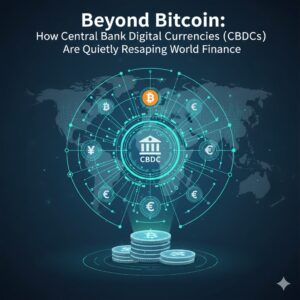
The Digital Fiat Revolution: Unlocking Efficiency and Inclusion
Why CBDCs promise to fix the broken plumbing of traditional finance and empower millions.
Tip: Watch Cross-Border Costs Vanish:
The current “SWIFT” system for international transfers is decades old, slow, and expensive, often taking days and costing significant fees. CBDCs operating on shared ledgers could allow for 24/7/365, near-instant international payments, saving businesses and individuals billions annually.
Curiosity: ‘Smart Money’ is Coming:
CBDCs can be “programmable.” This means money could be earmarked for specific purposes. Imagine government aid that can only be spent on food and housing, or business payments that automatically release only when goods are delivered and verified.
Tip: Bypass the Banking Bottleneck:
A key appeal of CBDCs is “financial inclusion.” In the future, you may not need a traditional bank account to access financial services—only a digital wallet issued or approved by the central bank. This could slash costs and provide essential services to the 1.4 billion adults globally who remain unbanked.
Curiosity: The End of ‘Too Big to Fail’?
By allowing citizens to hold risk-free digital cash directly with the central bank, CBDCs could reduce the systemic risk posed by commercial banks. This could lessen the economy’s reliance on private banks and potentially mitigate the need for massive taxpayer-funded bailouts during a financial crisis.
A Double-Edged Sword: The Hidden Risks of Programmable Money
How to Apply for the Chase Sapphire Preferred
Before we celebrate the end of bank fees, we must address the critical trade-offs in privacy and centralization.
The Privacy Conundrum: While CBDCs promise efficiency, they pose a significant challenge to financial privacy. Unlike physical cash, which is anonymous, a digital currency issued by a central bank could theoretically allow the government to monitor every transaction in real-time. This isn’t a deal-breaker, but it makes robust digital privacy laws and transparent governance more critical than ever. The challenge isn’t the technology itself, but rather implementing the strong legal frameworks required to protect individual rights while still preventing illicit activity.
Navigating Centralization Risks: The “programmable money” feature, while useful for specific aid, also raises concerns about financial control and overreach. The key risk is the potential for money to expire or be restricted without clear consent. This is precisely why most Western proposals are focusing heavily on “two-tier” systems, where private banks still manage the customer relationship. This maintains innovation and competition, ensuring the central bank simply provides the stable rails, rather than driving the train, thus mitigating the risk of absolute control.
The landscape of world finance is shifting at an unprecedented pace. For decades, the global economy has operated on a complex, often inefficient, network of correspondent banks, settlement systems, and fiat currencies. Today, disruptive technologies are challenging this status quo. From the rise of decentralized finance (DeFi) to the institutional adoption of digital assets, the very definition of “money” is being redefined. At the center of this transformation is perhaps the most powerful force of all: the central banks themselves.
Governments worldwide are no longer just observing the digital revolution; they are actively joining it. The exploration and development of Central Bank Digital Currencies (CBDCs) represent a monumental step, promising to enhance monetary policy, streamline payments, and promote financial inclusion. But this transition is not without its complexities. It forces us to confront fundamental questions about the role of the state in finance, the future of commercial banking, and the delicate balance between systemic efficiency and personal privacy.
Our Post


Do You Need to Know Everything About Finance to Invest in the U.S.?
outubro 7, 2026
Nenhum comentário
Read More »